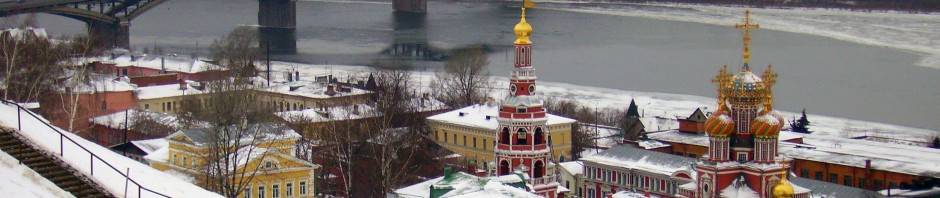
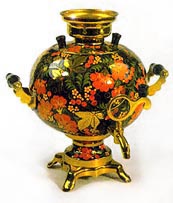
The samovar is an urn used by Russians to make tea. It both heats the water and seeps the tea. Tea has been a favorite drink of Russians since they started importing from China in the seventeenth century. They may serve tea at any meal or at any time of day, served strong and black and sweetened with honey, sugar or jams. In the early nineteen hundreds in Russia, there were stands on the street corners selling tea, and trains had samovars for the travelers.
The early samovars were made in Moscow, St. Petersburg, the Urals and several other provinces in Russia. These first samovars were utilitarian and made in many shapes, but soon a standard cylindrical form evolved and decorations were added so that some became beautiful works of art. The first factory to produce them was founded in Tula by Nasar Usitsin in 1778, and Tula has become the center of samovar production. The usual urn is around 18 inches tall, but can range up to two feet. Bronze was often used to make the urn, although early ones were made of other metals, some plated with gold or silver. The early ones used charcoal to heat the water and today, electricity is used with standard 110 or 220 voltage for those imported into the United States. While they can be used to brew tea, they are usually collected for their beauty.
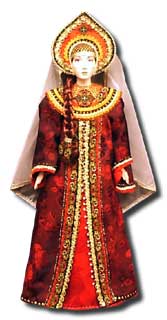 Russian National Costume
Historians suppose that traditional Russian costume started taking its shape in the 12th-13th centuries. It was during that period when intensive formative process of Russian ethnos was taking place. Russian costume, just like garments of all the Slavic population of Eastern Europe – i.e. Ukrainians and Byelorussians – was quite peculiar and in accord with living of the nation of tillers. Up to the 18th century it fitted well all layers of Russian society: it was worn by tsars, boyars, merchants, craftsmen, and peasants.A peculiar feature of Russian national costume was a big number of outerwear. The clothes were of throw-over and throw-open types. The throw-over clothes were put on through the head and the throw-open ones had a top-down slit and were fastened line-on-line with hooks or buttons.As a rule peasants sew clothes of their own fabrics – wool, hemp, staminate hemp, and linen. Poor families could purchase garments extremely rarely. If purchases occurred, though, it was done in turn, by clubbing of several families – first for one person, then for another, and so on. Even ritual garments, like wedding dresses, were available for collective use.The costumes of nobility were of Byzantium style. In the 17th centuries there came some borrowings from Poland, such as the Polish caftan (man’s long outer garment) and the Polish fur coat. To protect national originality the order of 6 August 1675 prohibited stolniks (a courtier rank below the boyar in Russia in 13th-17th cc), solicitors, Moscow gentry, dwellers and their servants from wearing foreign style clothes.
The Russian national costume lost its popularity after Peter the First banned it in 1699 for all except peasants, monks, priests and sextons. First he introduced into practice the Hungarian dress, followed by Saxon and French outerwear and German sleeveless jackets and underwear. Women were obliged to wear German dresses. All those who entered towns while wearing Russian clothes and beards had to pay duty: 40 kopeks from a pedestrian and 2 rubles from a person on horseback.By the early 20th century the most widespread women’s costumes were of two types: the South Russian one with poneva, i.e. a homespun woolen skirt, and the Mid-Russian one with a sarafan, i.e. a pinafore dress. A set of a skirt and knitted jacket became popular.The national Russian costume became still less popular after the revolution of 1917. However, in some villages, especially in the North of Russia, much of it is used till date. Samples of ancient folk clothes collected in museums and private collections of this country represent one of the most interesting phenomena of Russian culture.
 Ekaterina's world